Dilated Kidneys in Unborn Baby Boy Possible Conditions After Birth
After-Birth Abortion
The pro-pick case for infanticide.
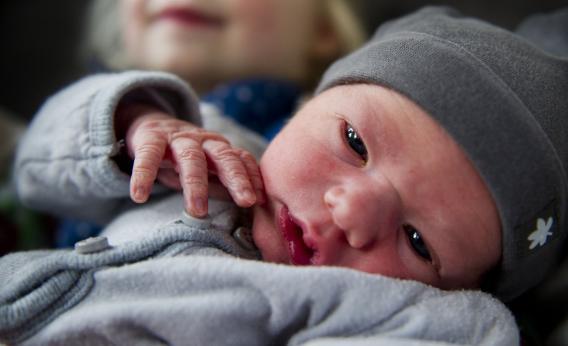
Photograph by Robin Utrecht/AFP/Getty Images.
Just when you thought the religious correct couldn't get whatever crazier, with its personhood amendments and its attacks on contraception, here comes the academic left with an even crazier idea: afterwards-birth abortion.
No, I didn't brand this up. "Partial-birth abortion" is a term invented by pro-lifers. But "after-nativity ballgame" is a term invented past two philosophers, Alberto Giubilini and Francesca Minerva. In the Journal of Medical Ethics, they propose:
[Due west]hen circumstances occur afterward birth such that they would have justified abortion, what we telephone call later on-birth abortion should be permissible. … [Due west]east propose to telephone call this do 'afterward-birth abortion', rather than 'infanticide,' to emphasize that the moral status of the private killed is comparable with that of a fetus … rather than to that of a child. Therefore, nosotros merits that killing a newborn could be ethically permissible in all the circumstances where abortion would be. Such circumstances include cases where the newborn has the potential to have an (at least) acceptable life, merely the well-being of the family is at risk.
Predictably, the article has sparked outrage. Last week, Reps. Joe Pitts, R-Pa., and Chris Smith, R-North.J., denounced it on the House floor. But it isn't pro-lifers who should worry about the Giubilini-Minerva proposal. Information technology'southward pro-choicers. The case for "after-birth abortion" draws a logical path from common pro-choice assumptions to infanticide. It challenges the states, implicitly and explicitly, to explain why, if abortion is permissible, infanticide isn't.
Let'southward expect at some of those assumptions.
i. The moral significance of fetal development is arbitrary. I ofttimes hear this argument from pro-choicers in the context of fourth dimension limits on abortion. In a debate terminal fall, I drew up a timeline of fetal development, calendar week by week. The response from Ann Furedi, principal executive of the British Pregnancy Advisory Service, was that it would exist capricious to utilize any indicate in that timeline to draw a legal limit on abortion rights. Giubilini and Minerva seem to share this view. "Abortions at an early stage are the best option, for both psychological and physical reasons," they write, clearly omitting the thought that abortions at an early stage are better than tardily ones for moral reasons. "Merely existence human is not in itself a reason for ascribing someone a right to life," they write. "Indeed, many humans are not considered subjects of a right to life," such equally "spare embryos where enquiry on embryo stalk cells is permitted" or "fetuses where ballgame is permitted."
Furedi accepts birth as the first logical fourth dimension limit, though not for reasons of fetal development. (Come across her comments 44 minutes into this video.) But Giubilini and Minerva push button beyond that limit. They note that neural development continues afterward birth and that the newborn doesn't yet run into their definition of a "person"—"an individual who is capable of attributing to her ain being some (at to the lowest degree) basic value such that being deprived of this existence represents a loss to her." Accordingly, they reason, "The moral status of an infant is equivalent to that of a fetus, that is, neither can be considered a 'person' in a morally relevant sense."
ii. Prior to personhood, human life has no moral claims on usa. I've seen this position asserted in endless comment threads by supporters of abortion rights. Giubilini and Minerva add only 1 further premise to this statement: Personhood doesn't begin until sometime afterwards birth. Once that premise is added, the newborn, like the fetus, becomes fair game. They explain:
[I]due north order for a harm to occur, information technology is necessary that someone is in the status of experiencing that damage. If a potential person, like a fetus and a newborn, does non become an actual person, like y'all and united states of america, then there is neither an actual nor a future person who can be harmed, which means that at that place is no impairment at all. … In these cases, since non-persons have no moral rights to life, there are no reasons for banning later on-nativity abortions. … Indeed, notwithstanding weak the interests of actual people can be, they will ever trump the declared interest of potential people to become actual ones, because this latter interest amounts to zero.
You may find this statement cold, but where'southward the flaw in its logic? If the neurally unformed fetus has no moral claims, why isn't the aforementioned true of the neurally unformed newborn?
3. Any burden on the woman outweighs the value of the child. Giubilini and Minerva annotation that philosophers such every bit Peter Singer have presented arguments for neonaticide for many years. Until now, these arguments have focused on what's best for the babe—in the words of recent Dutch guidelines, "infants with a hopeless prognosis who experience what parents and medical experts deem to be unbearable suffering." Giubilini and Minerva merely button this idea one stride further, calling their proposal "'after-birth abortion' rather than 'euthanasia' because the best interest of the ane who dies is not necessarily the principal criterion for the selection."
"Actual people'southward well-beingness could be threatened by the new (even if healthy) child requiring energy, money and care which the family might happen to be in short supply of," they discover. Accordingly, "if economical, social or psychological circumstances change such that taking care of the offspring becomes an unbearable burden on someone, then people should exist given the take chances of non being forced to do something they cannot afford." An later-birth abortion might be warranted by any "interests of actual people (parents, family, society) to pursue their own well-being"—including "the interests of the mother who might endure psychological distress from giving her child upwards for adoption."
4. The value of life depends on choice. Pro-choicers don't accept the idea that the path from pregnancy to motherhood, being natural, must be followed. They argue that the choice is up to the woman. Some assert that the life inside her has no moral status until she chooses to give nativity to it.
Again, Giubilini and Minerva but extend this logic across birth. Since the newborn isn't a person however, its significance continues to hinge on its mother's decision. Neonates "might or might non become particular persons depending on our choice," the authors debate. Until so, the newborn imposes no obligations on us, "because we are not justified in taking it for granted that she volition exist as a person in the future. Whether she will be is exactly what our choice is about."
5. Discovery of a serious defect is grounds for termination. Fetal development can plow tragic at any point. Most people agree that abortion should be permitted when a grave defect is discovered at amniocentesis. In the partial-birth ballgame argue, pro-choicers extended this rationale, arguing that abortions in the third trimester should be permitted when horrible defects were identified at that stage. Giubilini and Minerva take this argument to the next level, noting that defects often remain undiscovered until birth:
An examination of 18 European registries reveals that between 2005 and 2009 just the 64% of Downwards'south syndrome cases were diagnosed through prenatal testing. This per centum indicates that, considering only the European areas under examination, virtually 1700 infants were built-in with Downwards's syndrome without parents being aware of it before nativity. Once these children are born, in that location is no choice for the parents only to continue the kid, which sometimes is exactly what they would not have done if the disease had been diagnosed before birth.
The authors conclude that "if a disease has not been detected during the pregnancy, if something went incorrect during the delivery, or if economic, social or psychological circumstances change such that taking care of the offspring becomes an unbearable burden on someone, so people should be given the chance of not being forced to do something they cannot afford." And it isn't clear where the line against infanticide would be drawn. "We practice not put forward any claim almost the moment at which after-birth abortion would no longer be permissible," Giubilini and Minerva write. They dubiety that "more than a few days would be necessary for doctors to detect any abnormality in the child." But critics are already noting that many defects are discovered later.
In sum, the authors contend:
If criteria such as the costs (social, psychological, economic) for the potential parents are good enough reasons for having an abortion fifty-fifty when the fetus is healthy, if the moral condition of the newborn is the same as that of the infant and if neither has any moral value past virtue of being a potential person, then the same reasons which justify abortion should also justify the killing of the potential person when information technology is at the stage of a newborn.
I don't purchase this argument, in part because I agree with Furedi that something profound changes at nascence: The woman'southward actual autonomy is no longer at stake. But I besides think that the value of the unborn human being increases throughout its development. Furedi rejects that view, and her rejection doesn't terminate at birth. As she explained in our debate concluding fall, "At that place is nothing magical about passing through the birth culvert that transforms it from a fetus into a person."
The challenge posed to Furedi and other pro-pick absolutists by "subsequently-birth abortion" is this: How exercise they answer the argument, advanced by Giubilini and Minerva, that any maternal interest, such every bit the burden of raising a gravely defective newborn, trumps the value of that freshly delivered nonperson? What value does the newborn accept? At what bespeak did information technology learn that value? And why should the police force step in to protect that value confronting the judgment of a woman and her doctor?
William Saletan'southward latest short takes on the news, via Twitter :
Source: https://slate.com/technology/2012/03/after-birth-abortion-the-pro-choice-case-for-infanticide.html
0 Response to "Dilated Kidneys in Unborn Baby Boy Possible Conditions After Birth"
Enregistrer un commentaire