Quintilian the Art of a Good Man Speaking Well
This is the second in a series on classical rhetoric. In this post, we lay the foundation of our study of rhetoric past taking a look at its history. While this post is in no way a comprehensive history of rhetoric, it should give yous enough background data to understand the context of the principles we'll exist discussing over the next few months.
Humans take studied and praised rhetoric since the early on days of the written word. The Mesopotamians and Aboriginal Egyptians both valued the ability to speak with eloquence and wisdom. However, it wasn't until the ascension of Greek democracy that rhetoric became a high art that was studied and developed systematically.
Rhetoric in Ancient Hellenic republic: The Sophists
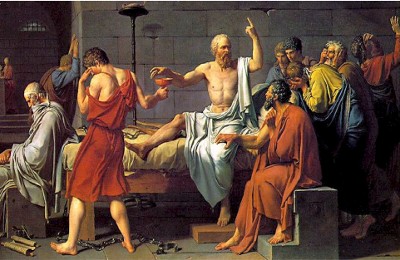
Many historians credit the ancient urban center-state of Athens as the birthplace of classical rhetoric. Because Athenian democracy marshaled every free male into politics, every Athenian man had to be fix to stand in the Assembly and speak to persuade his countrymen to vote for or against a particular slice of legislation. A man's success and influence in ancient Athens depended on his rhetorical power. Consequently, small schools dedicated to teaching rhetoric began to form. The kickoff of these schools began in the 5th century B.C. among an itinerant group of teachers called the Sophists.
The Sophists would travel from polis to polis teaching young men in public spaces how to speak and argue. The about famous of the Sophists schools were led by Gorgias and Isocrates. Because rhetoric and public speaking were essential for success in political life, students were willing to pay Sophist teachers nifty sums of money in exchange for tutoring. A typical Sophist curriculum consisted of analyzing poetry, defining parts of speech, and instruction on argumentation styles. They taught their students how to make a weak argument stronger and a strong statement weak.
Sophists prided themselves on their ability to win whatever debate on any subject even if they had no prior knowledge of the topic through the use of disruptive analogies, flowery metaphors, and clever wordplay. In brusk, the Sophists focused on style and presentation fifty-fifty at the expense of truth.
The negative connotation that nosotros have with the word "sophist" today began in ancient Greece. For the ancient Greeks, a "sophist" was a man who manipulated the truth for fiscal proceeds. It had such a pejorative meaning that Socrates was executed by the Athenians on the accuse of being a Sophist. Both Plato and Aristotle condemned Sophists for relying solely on emotion to persuade an audience and for their condone for truth. Despite criticism from their contemporaries, the Sophists had a huge influence on developing the written report and pedagogy of rhetoric.
Rhetoric in Ancient Greece: Aristotle and The Fine art of Rhetoric
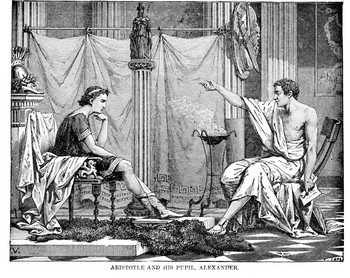 While the great philosopher Aristotle criticized the Sophists' misuse of rhetoric, he did see information technology as a useful tool in helping audiences see and understand truth. In his treatise,The Art of Rhetoric, Aristotle established a arrangement of understanding and teaching rhetoric.
InThe Fine art of Rhetoric, Aristotle defines rhetoric as "the faculty of observing in whatever given case the available means of persuasion." While Aristotle favored persuasion through reason solitary, he recognized that at times an audience would not exist sophisticated enough to follow arguments based solely on scientific and logical principles. In those instances, persuasive language and techniques were necessary for truth to be taught. Moreover, rhetoric armed a man with the necessary weapons to refute demagogues and those who used rhetoric for evil purposes. According to Aristotle, sometimes you had to fight fire with fire.
After establishing the need for rhetorical knowledge, Aristotle sets forth his system for effectively applying rhetoric:
- Three Ways of Persuasion (logos, pathos, and ethos)
- Three Genres of Rhetoric (deliberative, forensic, and epideictic)
- Rhetorical topics
- Parts of speech
- Effective use of style
The Art of Rhetoric had a tremendous influence on the development of the written report of rhetoric for the next two,000 years. Roman rhetoricians Cicero and Quintilian frequently referred to Aristotle'southward piece of work, and universities required students to reportThe Art of Rhetoric during the 18th and 19th centuries.
Rhetoric in Ancient Rome: Cicero
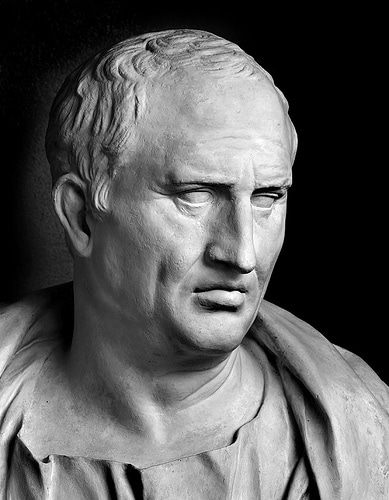
Rhetoric was boring to develop in aboriginal Rome, only it started to flourish when that empire conquered Hellenic republic and began to be influenced past its traditions. While aboriginal Romans incorporated many of the rhetorical elements established by the Greeks, they diverged from the Grecian tradition in many means. For example, orators and writers in ancient Rome depended more on stylistic flourishes, riveting stories, and compelling metaphors and less on logical reasoning than their ancient Greek counterparts.
The first master rhetorician Rome produced was the great statesman Cicero. During his career he wrote several treatises on the subject includingOn Invention,On Oration, andTopics. His writings on rhetoric guided schools on the discipline well into Renaissance.
Cicero's approach to rhetoric emphasized the importance of a liberal education. Co-ordinate to Cicero, to be persuasive a man needed knowledge in history, politics, art, literature, ethics, law, and medicine. By being liberally educated, a man would exist able to connect with any audition he addressed.
Rhetoric in Aboriginal Rome: Quintilian
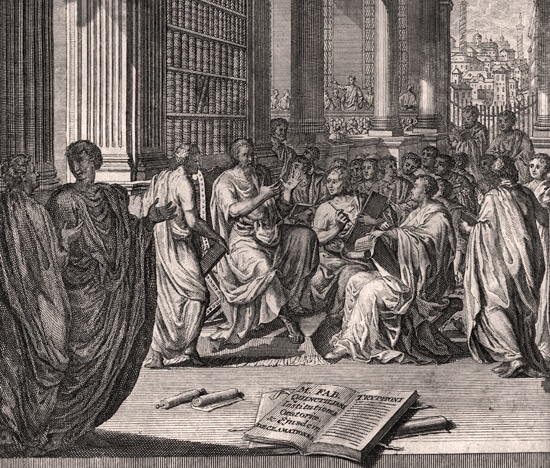
The second Roman to go out his mark on the written report of rhetoric was Quintilian. After honing his rhetorical skills for years in the Roman courts, Quintilian opened a public schoolhouse of rhetoric. There he developed a study system that took a student through dissimilar stages of intense rhetorical training. In 95 AD, Quintilian immortalized his rhetorical education organisation in a twelve-book textbook entitled I nstitutio Oratoria.
Institutio Oratoria covers all aspects of the art of rhetoric. While Quintilian focuses primarily on the technical aspects of effective rhetoric, he also spends a considerable corporeality of time setting forth a curriculum he believes should serve as the foundation of every homo'southward pedagogy. In fact, Quintilian's rhetorical teaching ideally begins as presently as a baby is born. For example, he counsels parents to notice their sons nurses that are articulate and well-versed in philosophy.
Quintilian devotes much of his treatise to fleshing out and explaining the Five Canons of Rhetoric. Outset seen in Cicero'sDe Inventione, the Five Canons provide a guide on creating a powerful speech. The Five Canons are:
- inventio (invention): The process of developing and refining your arguments.
- dispositio (arrangement): The process of arranging and organizing your arguments for maximum impact.
- elocutio (fashion): The process of determining how you present your arguments using figures of oral communication and other rhetorical techniques.
- memoria (memory): The process of learning and memorizing your speech communication and then y'all can deliver it without the employ of notes. Retention-piece of work not only consisted of memorizing the words of a specific speech, but also storing up famous quotes, literary references, and other facts that could be used in impromptu speeches.
- actio (commitment): The process of practicing how y'all evangelize your speech using gestures, pronunciation, and tone of voice.
If you've taken a public speaking grade, you were probably taught a version of the Five Canons. We'll be revisiting these in more detail in a later mail.
Rhetoric in Medieval Times and the Renaissance
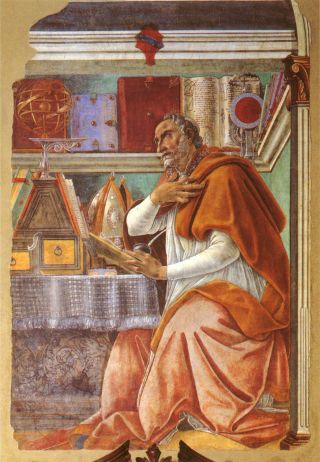
During the Middle Ages, rhetoric shifted from political to religious discourse. Instead of being a tool to lead the land, rhetoric was seen as a means to relieve souls. Church Fathers, like St. Augustine, explored how they could use the "pagan" art of rhetoric to better spread the gospel to the unconverted and preach to the believers.
During the latter part of the Medieval period, universities began forming in France, Italy, and England where students took classes on grammar, logic, and (you lot guessed it) rhetoric. Medieval students poured over texts written past Aristotle to larn rhetorical theory and spent hours repeating rote exercises in Greek and Latin to improve their rhetorical skill. Despite the emphasis on a rhetorical education, however, Medieval thinkers and writers fabricated few new contributions to the study of rhetoric.
Similar the arts and sciences, the study of rhetoric experienced a re-birth during the Renaissance menstruation. Texts by Cicero and Quintilian were rediscovered and utilized in courses of study; for example, Quintilian's De Inventione speedily became a standard rhetoric textbook at European universities. Renaissance scholars began producing new treatises and books on rhetoric, many of them emphasizing applying rhetorical skill in one's own colloquial equally opposed to Latin or aboriginal Greek.
Rhetoric in the Modern Solar day
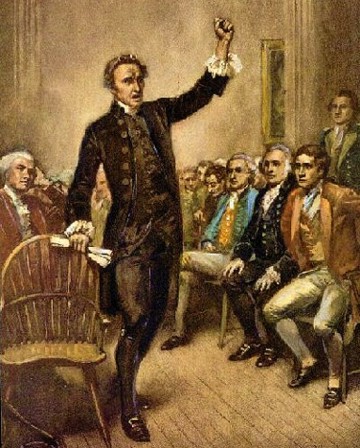
The rejuvenation of rhetoric continued through the Enlightenment. As autonomous ideals spread throughout Europe and the American colonies, rhetoric shifted back from religious to political discourse. Political philosophers and revolutionaries used rhetoric as a weapon in their campaign to spread liberty and liberty.
In the 18th and 19th centuries, universities in both Europe and America began devoting entire departments to the study of rhetoric. I of the about influential books on rhetoric that came out during this time was Hugh Blair's Lectures on Rhetoric and Belles-Lettres. Published in 1783, Blair's book remained a standard text on rhetoric at universities beyond Europe and America for over a hundred years.
The proliferation of mass media in the 20th century caused another shift in the report of rhetoric. Images in photography, film, and TV have get powerful tools of persuasion. In response, rhetoricians take expanded their repertoire to include not only mastery of the written and spoken word, merely a grasp of the visual arts as well.
Alright, that does information technology for this edition of Classical Rhetoric 101. Join u.s. side by side time as nosotros explore the Three Persuasive Appeals in rhetoric.
Classical Rhetoric 101 Series
An Introduction
A Brief History
The Three Means of Persuasion
The Five Canons of Rhetoric – Invention
The Five Canons of Rhetoric – Organisation
The V Canons of Rhetoric – Style
The Five Canons of Rhetoric – Retentiveness
The Five Canons of Rhetoric – Delivery
Logical Fallacies
Bonus! 35 Greatest Speeches in History
Tags: Speeches
Previous Next
Source: https://www.artofmanliness.com/character/knowledge-of-men/history-of-rhetoric/
0 Response to "Quintilian the Art of a Good Man Speaking Well"
Enregistrer un commentaire